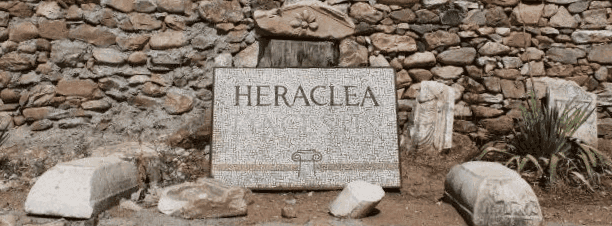
Heraclea Lyncestis
Located 2 km south from the city of Bitola at the foot of Mount Baba. Heraclea Lyncestis is an ancient Macedonian city, founded in the middle of the 4th century BC. by King Philip II of Macedonia and ruled later by the Romans.
It was named in honor of the mythological hero Heracles, the mythical hero and the founder of the Macedonian royal dynasty Argeadi. The epithet Lyncestis, meaning "Lincestid", comes from the name of the Lincestida region in which the city was located, and in which the ancient Macedonian tribe Lincestidi lived.
When the Romans conquered Macedon Heraclea survived and developed into a major crossroads on the Via Ignatia road, which linked Durres and Bosphorus. From Heraclea the road diagonally stretched towards Stobi, and then towards Serdika (nowadays Sofia).
WHAT TO SEE IN HERACLEA
-
Portico of the courtroom
The Portico dates back to the beginning of the 2nd century AD. It is a porch with a rectangular base whose roof on the north side leaned on the wall and on the south side on a row of columns. -
Therma – Roman baths
The building of the thermal spring means the birth of a higher health awareness among the local people. -
Roman Theatre
The theater had a capacity of about 3,000 visitors from all classes, it served both for theatre performances and gladiator games with animals. -
Small basilica
The Small basilica in Heraclea functioned, with several phases of reconstruction from the end of the 4th to the end of the 6th century AD. -
Large basilica
The Large basilica or Episcopal Basilica was a monumental building in Heraclea. Its rooms were paved with mosaics with excellent qualities made in the “opus tessallatum” technique with geometric, floral and zoomorphic motifs. -
The Episcopal residence
The Episcopal residence in Heraclea had a trapezoidal shape and, with its south side, was attached to the city wall.