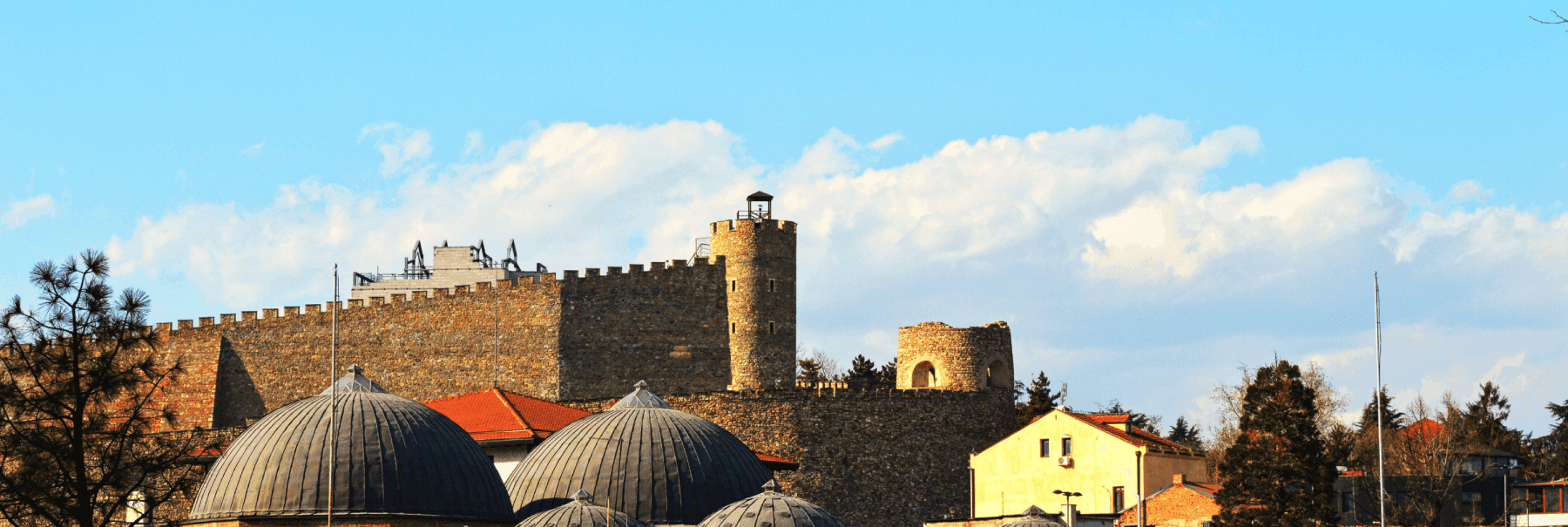
Skopje Fortress
The Skopje Fortress, commonly referred to as Kale - the Turkish word for 'fortress', is a historic fortress located in the old town of Skopje, on the left bank of the river Vardar. According to archeological excavations, the area on which today's fortress is located was inhabited since the prehistoric times. The fortress is depicted on the coat of arms of Skopje, which in turn is incorporated in the city's flag.
The Kale fortress originally was built in the 6th century AD on the land that was inhabited during the Neolithic and Bronze Ages (roughly IV to III millennium BC onwards). It was constructed with yellow limestone and travertine, which have fragments of Latin inscriptions on them. Material for the fortress originated from the Roman city of Skupi, which was completely destroyed by an earthquake in 518.
During the Ottoman rule, the fortress was neglected and the site was empty. A detailed description of its appearance during the seventeenth century was given by Evlija Celebija, a chronicler of the Ottoman Empire.
Skopje's Kale suffered great damage during the 1963 earthquake. The fortifications, defensive towers and buildings within the fortress were ruined, which contributed for its restoration to be considerably difficult. Its reconstruction was completed with the upgrading of the southwestern wall in September 2010, which was illuminated on the eve of the Independence Day of Macedonia.