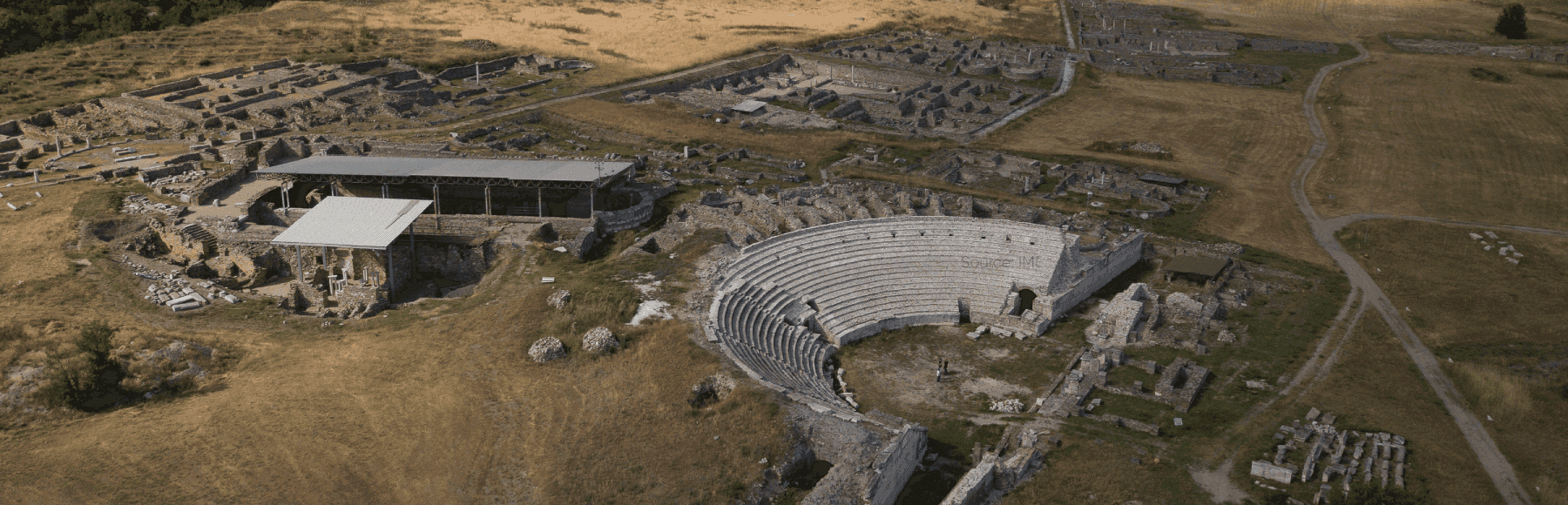
Stobi
Located near Gradsko, Macedonia, on the main road that leads from the Danube to the Aegean Sea and is considered by many to be the most famous archaeological site in Macedonia. Stobi is an archeological site that is surprisingly underrated. This ancient city was an economic and strategically valuable hub, and once the capital of a Roman province named Macedonia Salutaris.
Established somewhere in the Archaic period, this settlement was an ancient town of Paeonia, annexed later, around 200 BC, by Philip V of Macedon. Stobi got its name from an old Paeonian word, similar to a contemporary Macedonian word “stolb”, meaning pillar or post.
In 168 BC the city was conquered by the Romans. The territory of Macedonia became a Roman province and was divided into four independent republics, and then united once again after 20 years. During this period, Stobi would witness a significant expansion, becoming a municipium – city.
WHAT TO SEE IN STOBI
-
The Episcopal Basilica
The basilica dates from the 5th century AD, it was built in a Hellenistic manner with atrium, narthex (with a mosaic floor), and exonarthex with a double apse. On the south of the basilica is the impressive baptistery with magnificent mosaic composition. This iconic mosaic art is depicted on the Macedonian Denar coin and Macedonian Denar banknote. -
Via Principalis Inferior
This was a major street of the city running from the central basilica to the main town fountain, then to house of Partenius, the 'Palace of Theodosius' and the House of Psalms. -
The Palace of Theodosius
The palace was where the emperor Theodosius first stayed while in Stobi. The floor is covered with marble blocks and the peristyle with mosaics in the technique opus sectile. -
The House of Peristerius
It was a large living complex for several families and also had rooms for shops. The Peristerius family owned the rooms in the southern part of the complex. -
The Magnae Therma
Translated into Big Bath, consisted of two rooms: one large room with a statue and a pool made of stone blocks. The reconstructed bath was in use until late into the 6th century. It was discovered in 1931.